ConnectiCity on Leonardo Electronic Almanac

Our text about ConnectiCity has been just published on Leonardo Electronic Almanac, Volume 19, Issue 1.

Connecticity, Augmented Perception of the City
+ Interview, Statement, Artwork

by Salvatore Iaconesi & Oriana Persico

“We constantly re-interpret and transform the spaces around us. The ways in which we constantly personalize the spaces which we traverse and in which we perform our daily routines communicate information about emotions, knowledge, skills, methodologies, cultures and desires. This process takes place in digital realms as well, which start to ubiquitously merge with cities. Mobile devices, smartphones, wearables, digital tags, near field communication devices, location based services and mixed/augmented reality have turned the world into an essentially read/write, ubiquitous publishing surface. The usage of mobile devices and ubiquitous technologies alters the understanding of place. In our research, we investigated the possibilities to conceptualize, design and implement a series of usage scenarios, moving fluidly across arts, sciences

and the practices of city governance and community design. The objective we set forth sees the creation of multiple, stratified narratives onto the city, set in place by citizens, organizations and administrations. These real-time stories and conversations can be captured and observed, to gain insights on fundamental issues such as ecology, sustainability, mobility, energy, politics, culture, creativity and participatory innovation processes. These methodologies for real-time observation of cities help us take part in a networked structure, shaped as a diffused expert system, capturing disseminated intelligence to coagulate it into a framework for the real-time processing of

urban information.”

Full article is available for download as a pdf here.

Volume 19 Issue 1 of Leonardo Electronic Almanac (LEA) is published online as a free PDF but will also be rolled out as Amazon Print on Demand and will be available on iTunes, iPad, Kindle and other e-publishing outlets.


LEA Volume 19 Issue 1
Volume Editors: Lanfranco Aceti and Richard Rinehart
Editors: Ozden Sahin, Jonathan Munro and Catherine M. Weir

ISBN: 978-1-906897-20-8
ISSN: 1071-4391

Squatting Supermarkets and REFF featured on Memefest

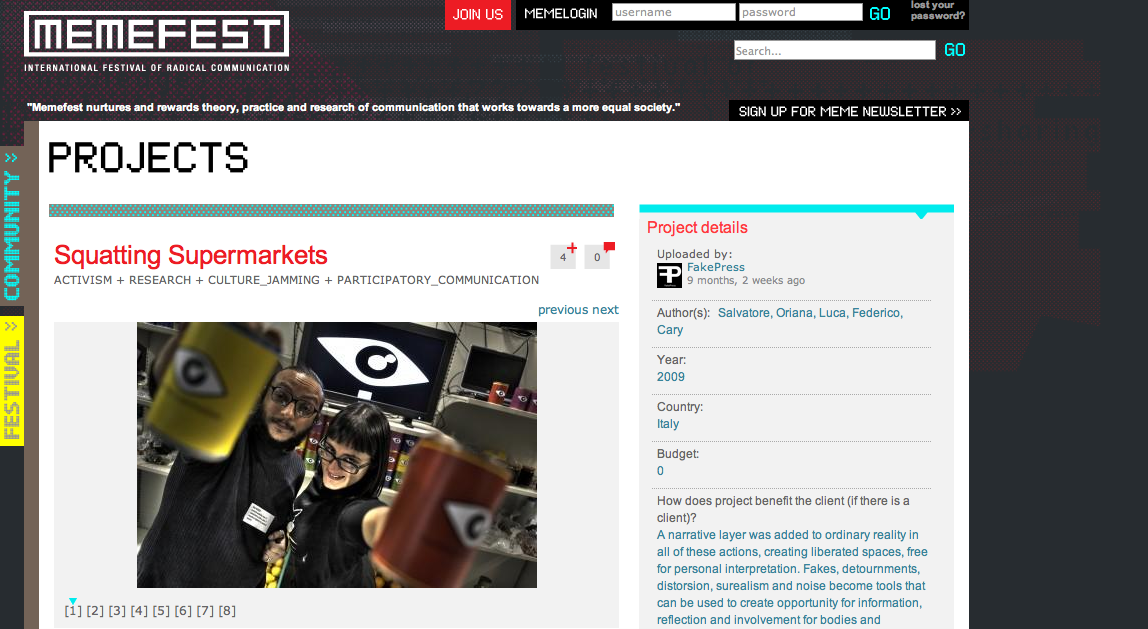
An update from a little while ago: Squatting Supermarkets and REFF have been featured at the Memefest.

REFF and Squatting Supermarkets at Memefest

REFF and Squatting Supermarkets at Memefest

Memefest is a international network of good people interested in social change trough sophisticated and radical use of media and communication. We create, think, research, educate and work on the intersections of art/science/communication profession/activism/theory and practice.

As a platform Memefest has two main dimensions. It is a festival and a collaborative community.

In this scheme we proposed our projects Squatting Supermarkets and REFF, RomaEuropa FakeFactory.

Squatting Supermarkets on Memefest

REFF on Memefest

Squatting Supermarkets as described on Memefest:

“Buying, wearing, eating, using. Our lives are full of objects of which we know very little about.

Shop’s and supermarket’s shelves only tell partial stories made from companies, efficient productions, happy farmworkers laying down coffee boxes on trucks with the logo of Nestlè, solar panels amidst fields and atop the roofs of factories who seem to have really stopped vomiting their foul toxic wastes in rivers and air, replacing them with new by-products of production that smell like straw and wheat.

All this happens if we look in one direction. And if we look in the other we see the aisles of the supermarkets spreading messages telling the tale of happy families (politically correct ones: a man, a woman, possibly mixing races and continents, with children, with the only possible alternative to be found in the images of career boys&girls, replacing family with business and fitness) buying things using credit cards, placing sincere trust in the ear of wheat almost protruding from the box of the product X that they throw into their shopping cart. Just as they trust the words biological, sustainable, ecologic showing up in products of all kinds.

Great commercial distribution points take narratives to an architectural level, designing our experiences up to the deepest levels of detail: the sequence of racks, shelves, themes, suggestions, colors, turns, tight spots; the reassuring sound announcing incredibly special offers; social, ecologic and economic themes, by which all bread is that of the old times, every shampoo has low ecologic impact, every automobile reduces polluting emissions, and any pack of coffee is produced by locals living on cheerful mountains upon which everyone peacefully smiles.

Visions that are partial, designed, mono-directional. Not all of the time. We must say that: luckily we can choose among many producers that have made the transition towards sustainability, ecology and the respect of diversities and of fragile populations. What we need to state is that for everything concerning these issues the possibility to access knowledge and information is an element of primary importance.

Art and creativity often confronted these points of view. The Supermarché Ferraille comes to mind with their improvised store displays, their surreal advertisements, their distorted products. Or the AdBusters, their subversive and detourned communication campaigns. Or the performances by Banksy, National Cynical Network.Or, in Italy, the ones by Candida TV, Serpica Naro, Anna Adamolo, Luther Blissett, Liens Invisibles. (… and loads of others. So much that it would be truly interesting to list and map all f the actions of this kind)

Squatting Supermarkets combines several platforms: iSee, an iPhone application used to create information and communication systems localized on logos and symbols; Ubiquitous Publishing, a set of open technologies that can be used to create location and architecture based contents, accessible directly from the places tht we walk through by using mobile phones and devices, together with simple, affordable augmented reality techniques; architettura rel:attiva, DpSdC and OneAvatar, a series of technological platforms that connect bodies and architectures to the internet and to virtual worlds.

iSee

Turning the corner of the aisle. Cold. Frozen products. Sounds of shopping carts, bottles, plastics, bags, cardboard, rolling pasta and cereals. Light completely white. Reds disappear or flatten completely, leaving out the reflections on the shiny plastic of serial packages of standard food items wih geometrically acceptable shapes.

Cold and words, in front and behind. Requests for information, calls to other aisles, requests for consensus, children getting lost.

A small accident takes place behind me, just as I lift a package taken randomly among others: two shopping carts collide, pouring out cardboard boxes, synthetic fibers holding together oranges that look all the same, bottles labeled in geometrically psichoactive ways. The fast bureaucracy of the accident ends and everything orderly starts back up : people start following their directional vectors, dictated bi habit and special offers.
I grab the pack back up, simultaneously extracting a smartphone from my pocket: a rapid automatic swipe of my thumb on the touchscreen unblocks it.

Colored icons in one hand, a cold, wobbly package in the other. I run through the icons, finding one with an eye insistently staring back at me, white on black. I activate the application and immediatly frame the package in the viewfinder: red, white, blu contour, thick typeface, readable. A short wait: “Product recognized: XYZ”. Options on the screen “Available information: ecological footprint, social responsibility and sustainability, alternative products. Or you can access the public discussion”.

Two goals.

On one side, to systematyze practices and technologies, creating an open framework that can be used and evolved to instantiate augmented reality (or, berret, Virtual NeoRealist) spaces, connecting bodies and information, implementing accessible, relational and natural interaction schemes.

On the other side, to act, starting multi-author, diffused, emergent narratives.”

REFF as described on Memefest:

“Romaeuropa FakeFactory is an act of artistic and technological hacking, a platform for global discussion and a performance that, beginning in 2009, has dealt with the themes of active, critical and creative innovation, confronting the management of cultural and technological policies related to these areas. The story begins with the opening of the Romaeuropa WebFactory, a digital art competition launched in 2008 by the Romaeuropa Foundation (Fondazione Romaeuropa) and Telecom Italia. Oppressive copyright conditions, such as the unilateral transfer of the rights to the works submitted and a ban on the use of techniques like mashup, cutup, remix but conversely giving the Romaeuropa Foundation and Telecom Italia the right to remix the works, inspired the creation of a Fake capable of becoming a point for multi-disciplinary analysis of the possibilities offered by freely available knowledge, contents and resources: a chance to reverse the logic of the competition and bring to light the contradictions, limits and implications of such a typical, reactionary cultural policy.

“Remix the world! Reinvent Reality!” is one of the principal themes that has inspired the REFF, from an act of détournement and cybersquatting – that brought to life the creation of a remix skills competition determining in 2009 a reversal of the Romaeuropa Foundation and Telecom Italia’s policy on the management of intellectual property rights – to the presentation of REFF’s instances and methodologies to the Cultural Commission of the Italian Senate (Commissione Cultura del Senato della Repubblica Italiana), up to the current production of the REFF book, as a global effort to create a working business model that implements the concepts and demands expressed by the RomaEuropa FakeFactory. Supporters of the REFF are found all over the world: over 80 partners among universities, artists, academies, associations, hackers, researchers, designers, journalists, politicians, magazines, networks, activitst, art critics, architects, musicians and entrepreneurs together with all the people who share a belief that art, design and new technologies can unite towards a critical, yet positive vision of a world that can create new opportunities and new ways of being, collaborating and communicating.”

The projects will be featured in a publication produced by Memefest in the next part of the year.


REFF on RomaCreativa

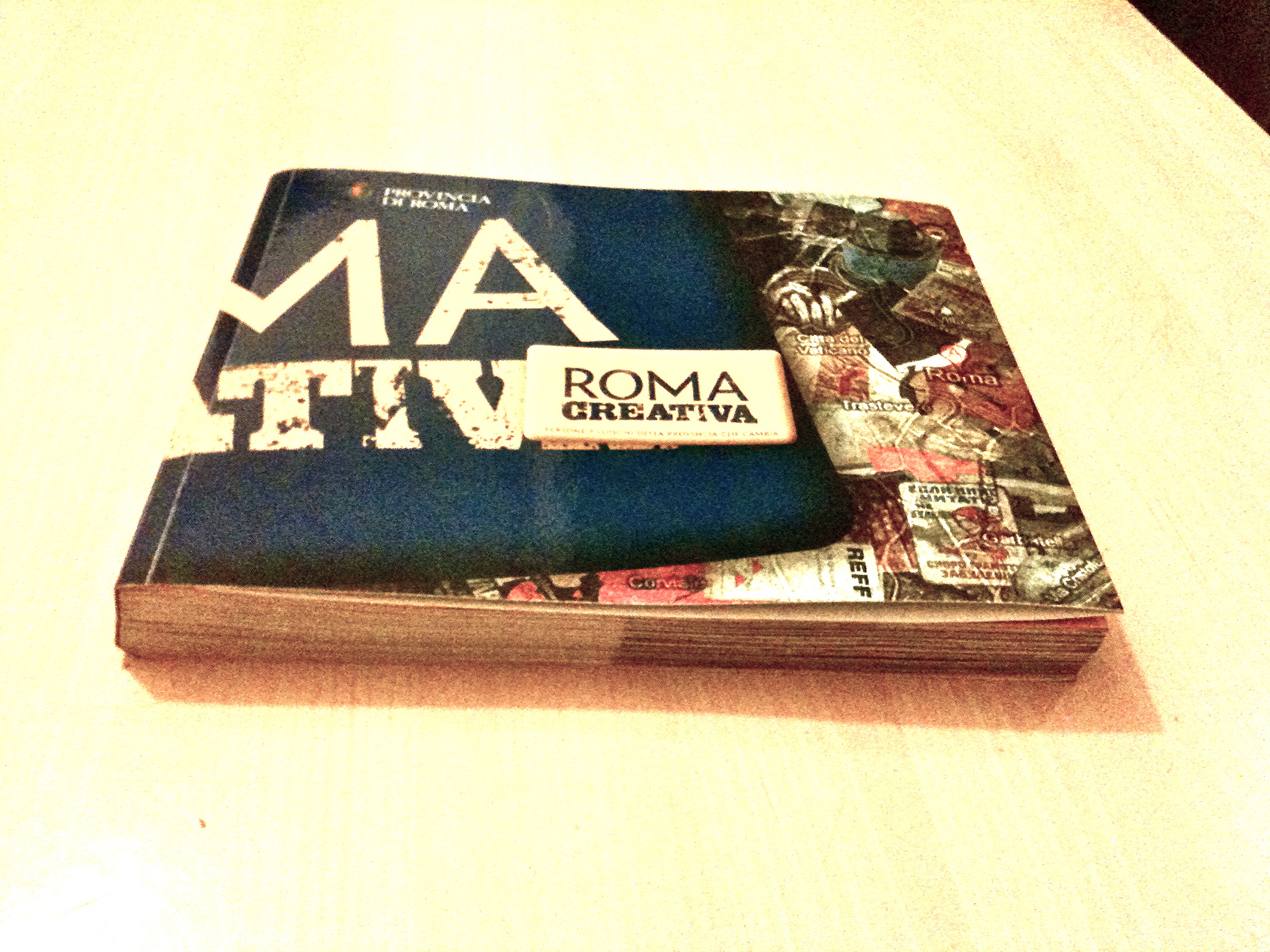
REFF, RomaEuropa FakeFactory has been featured in the Roma Creativa book, produced by the Administration of the Province of Rome to gather and publish the best creative talents in the italian capital’s area.

Here’s some views of the publication:

REFF on Roma Creativa

REFF on Roma Creativa


REFF on RomaCreativa

REFF on RomaCreativa


READ MORE ON ROMACREATIVA

CoS, Consciousness of Streams, after Transmediale.11

Just back from transmediale festival in Berlin we present you with the first results of the CoS, Consciousness of Streams project.

CoS, Consciousness of Streams

CoS, Consciousness of Streams

CoS, Consciousness of Streams has been an incredible experience!

CoS is a cross media publication by FakePress creating a realtime, emergent, multiauthor emotional map of the world by using ubiquitous technologies and natural interfaces.

Created by FakePress and Art is Open Source for the 2011 edition of the Transmediale festival in Berlin, CoS will be FakePress’ next publication.

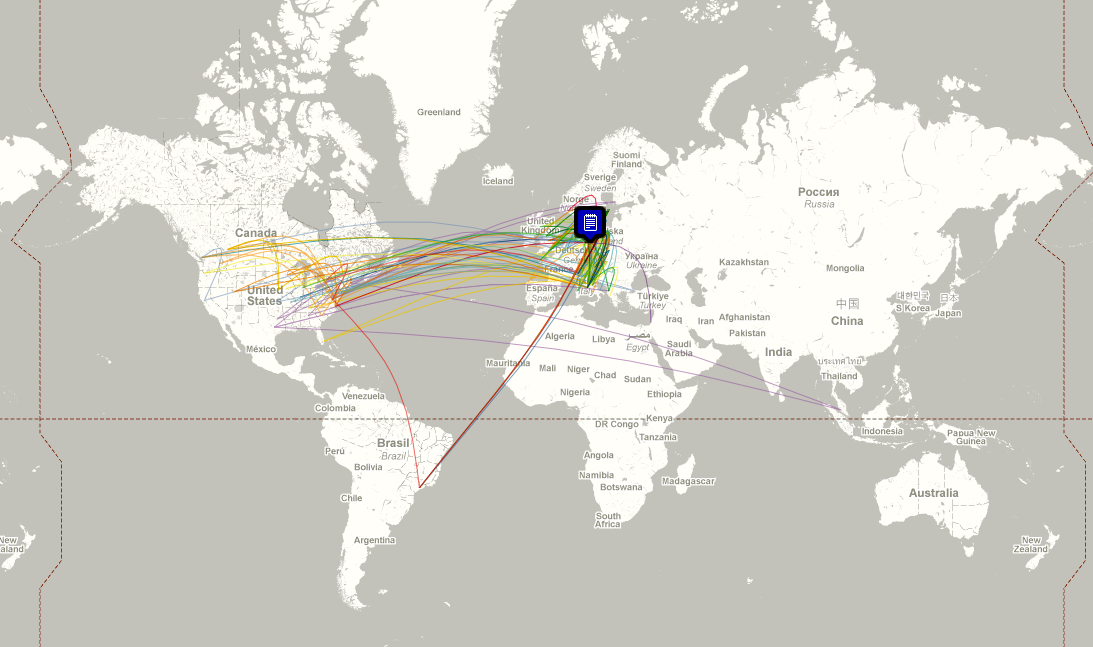
With numbers such as 35000 active authors, 230000 emotions, 4 source continents and more than 300 urban locations, CoS is a massive project! It is probably one of the most widespread publications made by a publishing house, and the experience is not over, with people from all over the world being able to continue adding to the book by using the ubiquitous interfaces which we have provided on the web, smartphones and dedicated kiosks called Disseminated Nodes.

As all publications by FakePress, CoS is an experiment in creating new forms of “books”, whose main characteristic is to be platforms for the expression of multiple authors (potentially every human being can be a CoS author). Each book is released together with the software/hardware platform used to create it, licensed under GPL3 schemes.

During transmediale, the CoS platform and the concepts behind its design, have been analyzed together with the visitors of the festival: 6 workshops totalling more than 24 hours of education and knowledge sharing processes have been presented to various groups of festival visitors.

From this activity, more than 6 projects will directly spawn from the CoS platform.

here is a short video from the CoS Headquarter in transmediale, taken on the last day of the festival:

To visit CoS go to :

http://cos.artisopensource.net

to visit FakePress:

http://www.fakepress.it

to visit transmediale:

http://www.transmediale.de

CoS, Consciousness of Streams

CoS Consciousness of Streams

CoS Consciousness of Streams

In just a few days we will be at transmediale in Berlin, to create CoS: Consciousness of Streams!

CoS will be something that we’re calling a cognitive virus on the festival, as it will be a cross-medial, emergent, performative, multi-author publication created by processing the festival itself: what goes on, how people move and feel, what people do at workshops, their ideas, connections and expressions.

The definition of CoS went through various stages and we defined it the way you will see it at transmediale by transforming  the initial proposal to harmonize it with the rest of the event, to what will be going on in the other spaces and, last but not least, with budget constraints :)

For download (PDF): CoS Consciousness of Streams Proposal, first version

The second version of the proposal describes what you will actually find at transmediale:

For download (PDF): CoS Consciousness of Streams Proposal, second version

For download (PDF): CoS Consciousness of Streams Proposal, notes to the slides of the second version

From the concept:

“Far from the image of Rodin’s Thinker, the contemporary world definitely abandons the idea of an isolated human, forming thought, ideas, concepts and shapes by isolation, contemplation. “Cogito, ergo sum”, yes, but thinking becomes a very different practice in respect to what had been envisioned by Descartes, transforming the ideas of contemplation, attention, conception, cognition : influencing and open-sourcing them to a series of additional channels and challenges which are enabled by the extension of our bodies and sensory systems through digital technologies.
Multiple sources, different timescales, contemporaneous, asynchronous, overlapping sources, interleaved attention spans that leave linearity behind in favor of networkedness; unconscious becomes predominant; an informant sound forms from the mutual suggestions that all information samples provide along a polyphonic multidirectional timeline in which interference, difference and noise are possibly the most important things to take into account.
Harmony/linearity leaves the stage, enters noise/nonlinearity, deconstruction, emergency and ubiquitousness. Multiple realities overlap, possibly denying each other and forming a neo-reality, that is browsable, filterable, mixable, mash-up-able, sharable, confrontable, storable, morphable, synthesizable, aggregatable.
Cognitive spaces form around fake, unverifiable, temporary bits of information whizzing by, at incredible speeds, clustering and disassembling along complex emergent patterns: multiple, anonymous, collective.
Connect the dots: each emerging shape is different and unrelated, yet it is the explicit expression of the same voices involved.
Time disappears replaced by immaterial places for our traversal: immediatcy; near-past; short time-spans; multiple time scanning; global timezones; recurring times; loops; feedbacks.”

CoS observes the novel condition of networked humanity, definitively suspended in a condition of continuous-present and delegating the ideas and perceptions of past and future to external mechanisms and devices.

CoS Consciousness of Streams - general architecture

CoS Consciousness of Streams - general architecture

The main idea of CoS is to create an additional, interpretative, layer of reality, to stratify it on top of the festival and to provide collaborative access to it to everyone (present, remote, connected… ), thus multiplying the voices and expressions defining the many versions of reality which we all experience.

From the concept:

“The immersion in the global stream of consciousness forming the current cognitive scape can be seen as an emersion. Dive right through media and emerge from the other side, in a reality that completely changes.
COS, Consciousness of Streams, is a complex yet natural initiative imagining the explosion of our human condition into an observable form.
COS is an environment, a series of networked workshops, a performative practice, an observation/representation methodology, and a second order cybernetic system resulting in an open-ended, on-going, multi-author, emergent, ubiquitous publication.
COS aims at disarticulating the practices of human beings and reassembling them from vantage points for expression and investigation: Identity, Time, Emotion, Place.
Each vantage point is a multidirectional observer: COS uses interfaces and interactions to observe individuals who, in turn, observe COS to form their physical and emotional state.
COS produces and analyzes streams: as a series of matrioskas, the environment is embedded into its container, and into the physical, digital and hybrid realities. The vantage points can be used to explore any level of this containment/intersectional hierarchy and, in turn, are affected by the whole system and by its
individual components.
COS, Consciousness of Streams, hosts the streams of consciousness of the people traversing it or attending its workshops as well as the ones of the global population of the social networks: in, out, in-between, in time, space, relations, difference.
COS is formed by poles focused on the vantage points and implementing interactions that guide individuals through a unique experience through a disassembled reality.
COS gathers all these experiences, and the ones of the people online and transforms them into information, expressing them through practice (the workshops), representation (the cross-medial environment) and performance (the collaborative/performative parts of the workshops).
COS expresses and then observes itself: the technological system embedded in various ways along the whole of COS aim at creating an ongoing experience.
A CMS (Content Management System) uses COS to produce an innovative form of publication, whose process does not end with the event: an open-ended, ubiquitous, multi-author, emergent, augmented reality, cross-medial publication that can be printed, interacted with, used through a location based system and by an augmented reality system: layered over the world and its stratified reality, in a continuous stream.”

CoS is a performative artwork that assumes the form of an interactive framework. The performance will be on-going, meaning that it will still be accessible after the festival, transforming it into a real, open, usable environment.

The technology used and created for CoS will also be accessible, under the forms of OpenSource APIs (Application Programming Interfaces) available to create additional functionalities for CoS, and as the framework itself, released under a GPL3 license right after the festival.

Everything happening at CoS will be part of the project/performance: the workshops, interactions, connections, expressions. Everything that people, present or remote, will decide to share will be included in the publication/environment, thus opening up the space and making it accessible, usable and reinventable.

Hope to see you all at transmediale for CoS, Consciousness of Streams.

Learn more about CoS, Consciousness of Streams at these links:

CoS Consciousness of Streams at Transmediale, including Workshops and installation information

we are participating to a number of conferences at transmediale: program found here