New forms of writing: augmented reality and ubiquitous publishing in Pompei

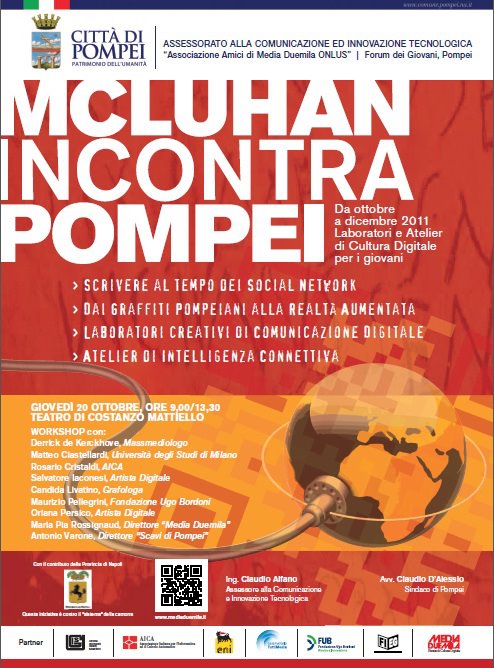
McLuhan meets Pompei. On October 20th 2011 we will be in Pompei for an event in which we will engage the new forms of writing enabled by ubiquitous technologies and augmented reality.

McLuhan incontra Pompei

McLuhan incontra Pompei

Organized by MediaDuemila as an event for the centennial celebrations of the birth of Marshall McLuhan, the event will feature the official launch of a project dedicated to knowledge, education and scientific experimentation dedicated to the students and young generations of the city of Pompei: “McLuhan meets Pompei: writing in the times of Social Networks. From graffiti to Augmented Reality”.

Derrick de Kerckhove, MediaDuemila’s scientific director, will lead the project which will have its official start

October 20th, from 9:00am to 1:00pm
at the Theatre “Di Costanzo e Mattiello”
Pompei

and will present the fundamental contributions by:

  • Matteo Ciastellardi (University of Milan, University of Barcelona)
  • Salvatore Iaconesi and Oriana Persico (University of Rome “La Sapienza, FakePress Publishing and Art is Open Source)
  • Candida Livatino (Graphologist)
  • Maurizio Pellegrini (Ugo Bordoni Foundation)
  • Maria Pia Rossignaud (Director of “MediaDuemila”)
  • Antonio Varone (Director of the “Scavi di Pompei”)

The project will continue in December with a Connective Intelligence Atelier and with the creative laboratories for digital communication titled “The Electronic Man and the Digital Wall”, promoting the acquisition of knowledge and skills on ubiquitous technologies and media, and the reflection on global society, characterized by the continuous interconnection of human beings, cultures, nationalities and languages, just as forecasted by McLuhan.

Here on MediaDuemila you can find a short text that describes our intervention in the event and in the project.

Here are some extracts, translated in english:

“Ubiquitous technologies materialize new and fascinating forms of writing as well as new forms of sensibility and planetary awareness, in a scenario which sees our perception of the world radically mutated.

[...]

The impacts of this mutation have effects on the ways we work, learn, communicate, relate and spend our free time. Digital networks and technologies are at the base of this mutation and determine a drastic change in out models for thought and expression.

[...]

In ‘The Electronic Man’ a suggestive and effective narration shows these new spaces for possibility and opportunity, and makes them observable.
A global performance forms the foundation of a research project which has been able to enact a new form of planetary writing and sensibility.
Thousands of QRCodes have been disseminated by internet users in their cities, and are forming the access portal to participating to this global experiment: the creation of a connective body and identity, and the acquisition of an externalized, added sensoriality, through a technological device.

[...]

As of today, around 50 thousand people all over the world participated to the performance/experiment, creating a scenario which bears very high interest for scientific and cultural research, due to the material possibility to observe and experience these novel possibilities: accessible ubiquitous technologies, relating people across multiple cultures and social contexts, on a planetary scale; augmented reality, ubiquitous publishing, natural interfaces and geo-referenced systems which are able to create and enable usage of new forms of writing, new sensibilities and tools for awareness and communication.

[...]

In Pompei the technologies used for the Electronic Man project will be explained and given to students and teachers. Together with them we will create a performative workshop in which these methodologies and techniques will be used in practical scenarios, inventing new forms of citizenship and processes which are able to narrate the story of the territory, people’s identities, the value of the production and the richness of the culture of the land and of the people who inhabit it.

[...]

Appropriating these languages, creating usage grammars for them, freely activating them in our daily lives: these are becoming the conditions and toolsets of the global citizen and of a new form of citizenship which is truly capable of transforming human beings into active agents of our societies, more aware, tolerant and conscious of the value of its territory and of fellow human beings.”

Leaf++, leaves, nature and augmented reality

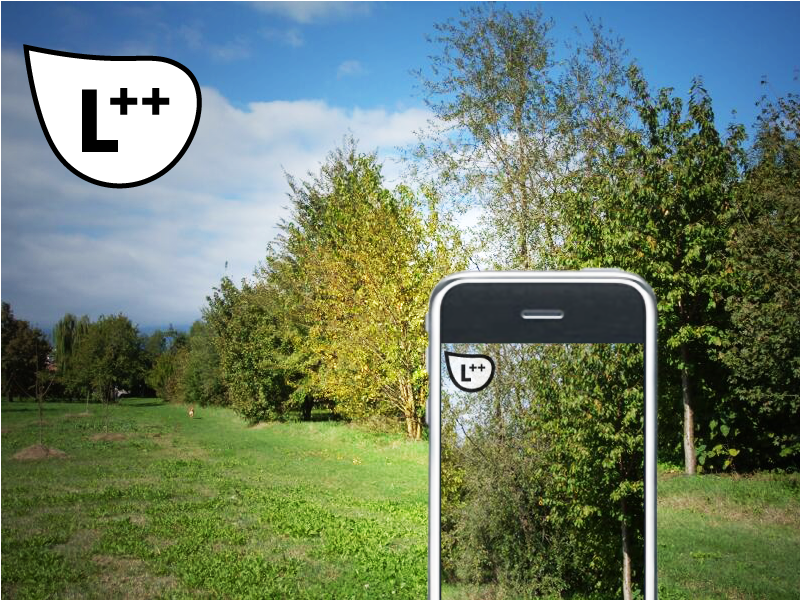
Leaf ++ augmented reality for leaves

Leaf ++ augmented reality for leaves


We just published an article on Media Duemila describing the Leaf++ system we will publish with FakePress at IESA 2011 in Istanbul.

Leaf++ is an augmented reality application that lets you get information about the natural environment around you.

It uses computer vision techniques to try and identify the leaves which you frame in your smartphone’s screen. As soon as the leaf is recognized information starts to popup on the screen, with no additional interaction needed: the name of the plant, its geographical origin, the fruits, woods, products it produces, etc.

From the article:

“The technological ecosystem in which we live allows us to reappropriate wisdom and knowledge of the natural world by creating fruition models for information that make this kowledge accessible in natural, usable ways”.

And:

“The ecologist dimension of Leaf++ suggests an innovative approach to the definition of new forms of citizenship in which technologies contribute to enabling a new concept of ‘citizen’ that is more aware, active and informed on the environment and the society he/she lives in, being able to collect information and transform them into knowledge, usable to lead sustainable, tolerant, environment-friendly lifestyles.”

Leaf++ is a joint effort of the whole FakePress team, and it was inspired by Luca Simeone and engineered by Salvatore Iaconesi.

Read the whole article HERE

Squatting Supermarkets @ Scighera, Milan

getting ready for Squatting Supermarkets at la Scighera, in Milan

http://www.lascighera.org/e-ancora-magnaven-e-semper-beveven-barbera-squatting-supermarkets

http://www.artisopensource.net

http://www.fakepress.net

Sunday, January 24th 2010 – 21:00 – 23:30

Conference Biofeedback

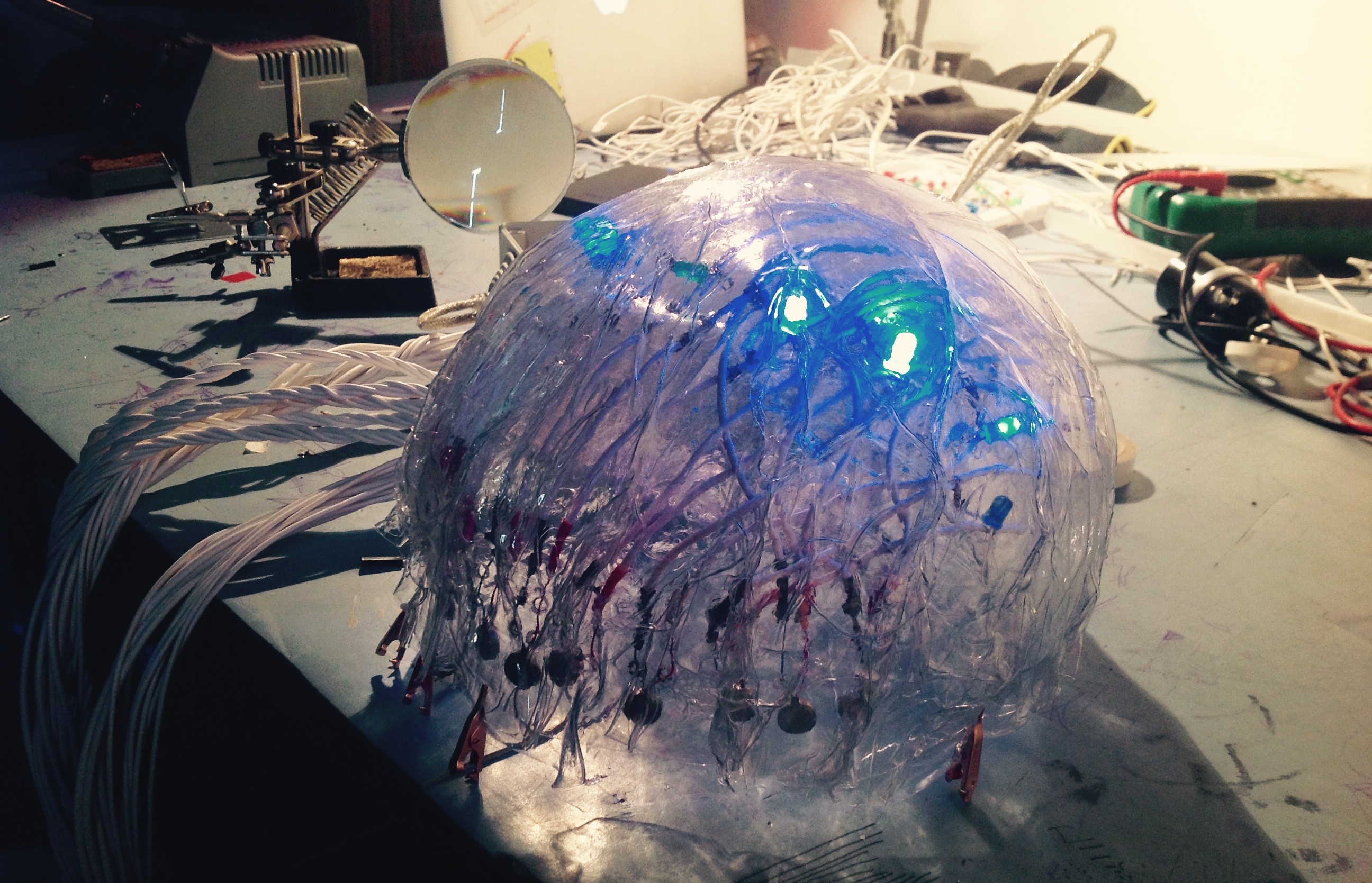
Conference Biofeedback is a USB gadget that allows conference lecturers to receive physical stimulations and feedback coming from the audience.

Are people interested in what you’re saying?
Are they bored?
Now you can know.
Lecturers can connect to their audience using their own bodies. Conference Biofeedback’s circuit are connected to an online application.
People in the audience can use the application’s interface to express their feelings about the conference.
Everything goes smoothly for the lecturer if they’re happy and interested.
If they happen to be bored, Conference Biofeedback triggers electrical stimulations (20V, just above human body’s natural impedence) with increasing current flow, rising proportionally to people’s boredom.
An annoying alarm and light signals complete the feedback experience.
Conference Biofeedback: a war on boring conferences and on unidirectional communication.
Conference Biofeedback was presented for the first time at Planetary Collegium’s 2009 annual conference “Consciousness Reframed X: Behaving Media, Experiencing Design”.

more info at:

FakePress