Eisenhower Fellowships: a journey through the changing scenarios of leadership, innovation and creativity

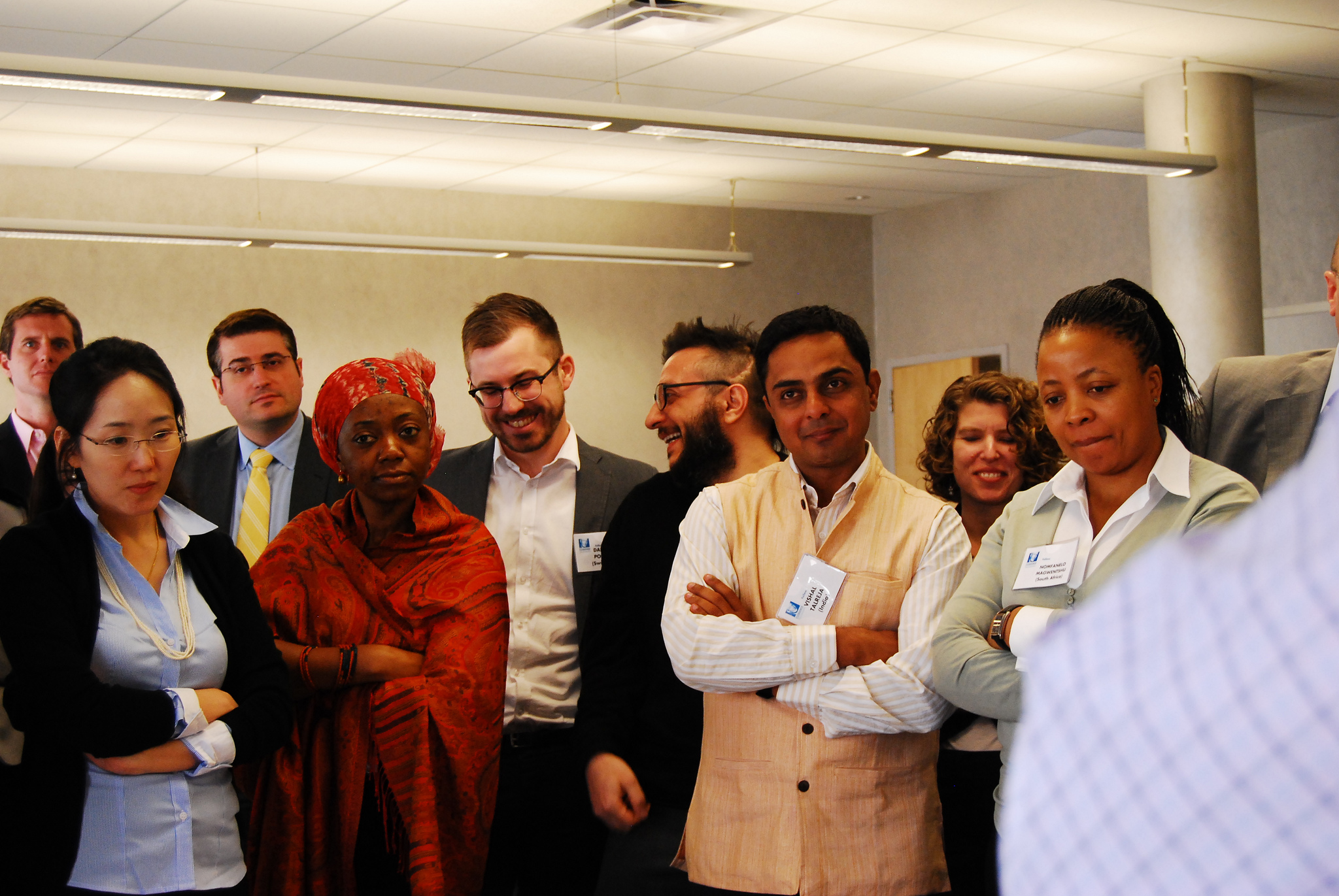
Salvatore Iaconesi will be on his Eisenhower Fellowship to explore the changing scenarios of leadership in the US, and to understand the opportunities for collaboration and exchange among the arts, sciences, humanities, businesses and public policies.

Eisenhower Fellowships

“identifies, empowers and links outstanding leaders from around the world, helping them to achieve consequential outcomes across sectors and borders. EF provides a transformational experience leading to lifetime engagement in a global network, where dialogue and collaboration make the world more prosperous, just and peaceful.”

Art is Open Source, through Salvatore Iaconesi, will be on the fellowship to explore various types of scenarios.

As we know, everything around us is changing at incredible speed.

The ways in which we learn, express, collaborate, work, consume, relate, exchange information, knowledge and wisdom are very different from they were even a few years ago.

Touched by the impact of digital cultures, the world has mutated and continues in this transformation.

This has extreme, radical impacts on human societies and on the ways in which we can imagine shaping our public policies: our perception of private and public spaces has changed, just as much as what we perceive to be legal/illegal, possible/impossible, suggested/forbidden. Just as our visions, imaginaries, opportunities.

We are in a situation in which giving answers has become not only very difficult, but also not very interesting. What is interesting, today, is to understand what the fundamental questions are, and to create open spaces for discussion, and for their continuous, iterative, participative assessment.

Many signals exist around us that can help to observe – just like anthropologists, ethnographers and cultural geographers – the ways in which things are changing in human societies. These signals can be collected in large quantities and observed according to a series of different approaches: for business, science, art, research, culture, commerce, policies…

We can also imagine collecting these signals to enact some form of forecast.

Possibly the most interesting thing which we can do is to take these signals into account to observe our present and what it says about our near-future, to see which new daily rituals they describe, new ways of doing things, new habits, new things that we have learned to give for granted, or that we have forgotten about.

And to use these observations to create things, be them objects, products, services, processes: real ones, possibly under the form of live prototypes that can be used to inspire further, materialized observations about our near-future.

Some call if Design Fiction, some call it near-future design: what is certain is that it is a practice that needs the contribution of the artist just as the ones of the scientist; of the engineer and the poet; of the businessman and the designer; of the anthropologist and the architect; of the technologist and the politician. In a joint effort to understand, create and leverage the layers of meaning emerging from our human societies.

This is what we will do during this Eisenhower Fellowship, collecting the experiences of leaders throughout the USA, suggesting change and creating the opportunities for exchange and collaboration for a better understanding of our present and of what will come up next.

Eisenhower Fellowships

Eisenhower Fellowships


Radical Openness: Art is Open Source at TED Global 2012

TED Global 2012

TED Global 2012

Salvatore Iaconesi of AOS has been nominated TED Fellow for 2012 and, for this, will be presenting at TED Global 2012 in Edinburgh from June 25-29 2012.

We’ve been reflecting on this incredible opportunity for the last few weeks.

TED Global’s theme for this year is Radical Openness, which is something we’re really interested in.

At Art is Open Source we focus on the transformations which have been brought on to human beings by the wide and ubiquitous availability of digital technologies and networks.

Everything has changed in the last few years: the ways in which we learn, work, relate, consume, communicate, experience.

We have redefined our idea of identity, place, time, privacy and public space.

And the transformation is so fast that it is really difficult to provide “answers” when questions are asked.

This, possibly is more of a time when it is more important to understand how to ask the right questions than to provide answers.

Yes, because the scenarios for further change of our lives on this planet are so many and so visionary that we’re really in need to be able to maintain focus on the basics.

How can we use all the technologies and practices which have emerged in these last few years to promote a better life for us, the people we love and the planet itself?

It still seems as if human beings are still right in the middle of this discussion.

Take the smartest of the cities, filled with sensors and cloud infrastructure and real-time systems for environment and social life, and it immediately becomes useless if citizens are not aware and conscious of their possible new roles in society.

At AOS, we’re really for human beings. For their ability to be aware, active, insightful, ethical, tolerant, caring, collaborative and constructive, if only they have the right tools, motivations, relations, contexts and social environments.

And we’re definitely for the opportunity to facilitate, amplify and enhance these powerful human characteristics, provided by ubiquitous technologies and networks.

We feel that among the most pressing issues which we will need to face in the near future to activate these opportunities will be to expand our ability to become active and aware citizens, and to redefine our possibility to interconnect and express ourselves.

And to design the ways in which these technologies and networks can be used to connect people everywhere, in the middle of New York City as well as in the middle of a desert or on top of a high mountain.

As we all know by now, fundamental problems afflicting the population the remote parts of our planet – such as water, health and food – are problems which are centered on knowledge: access knowledge and know-how and you will have your water.

And, on top of that, people are constantly producing new knowledge: from the small innovation of their daily lives, to the enormous discoveries coming from scientific research.

The problem is that most of the time these innovations remain limited in scope, and end with the person or group who created them.

This, we feel, is the great opportunity of our times: transform the sensibilities, creativities, inventions, insights, knowledge, traditions of individuals into usable, perceivable, situated, ubiquitously available knowledge for the rest of the planet, promoting new forms of sustainable, inclusive business, new forms of governance, new opportunities for sociality, culture, arts and expression.

This is what we will talk about at TED Global 2012 in Edinburgh.

Be there!

Activist develops a smartphone app to get people out of danger zones from Merlien Institute on Vimeo.